Cooking lessons
Story by a current IVEP host


Editor’s note: Jennifer and Jonathan Murch are currently hosting Eucefe Wirissone, an IVEP participant from Mozambique. Eucefe has been assigned as regenerative carbon farming internship and field research assistant at Jubilee Climate Farm in Harrisonburg, Virginia. IVEP provides opportunities for both hosts and participants to exchange their cultures, often through food. The intentionality of spending time preparing ingredients, learning and paying attention to specific steps, and eating the meal together is what makes the experience meaningful and memorable.
Top photo: Eucefe Wirissone joyfully shows Jennifer how to cook xima. Photo/Jennifer Murch
“How much are you adding?” Eucefe (pronounced YEW-sef) asks, peering at the measuring cup of meal I’m holding.
I’m making xima — or trying to. I’m not even sure if I have the right meal. After visiting South Africa last year, I bought a white maize meal to recreate pap, the country’s thick, mashed-potato-like staple. From what I can tell, South African pap is similar to what Eucefe says they eat in Mozambique — only there, it’s called xima (pronounced SHE-mah).
But now Eucefe says I’m doing it wrong. I’m adding way too much meal. Or maybe too much water?
“It’s too much,” he says, but his limited English prevents him from fully explaining and I’m not sure which part I’m messing up.
I hand him the cup. “You do it.”
He takes over, sprinkling the meal into the boiling water a little at a time, stirring so vigorously the pot rattles against the stovetop.
“Should I add salt?” I ask. Salt makes everything better, and some recipes I’ve read call for it, but Eucefe shakes his head. That’s not how they do it.
When the xima is ready, he asks for a bowl of cool water. As he transfers thick, steaming scoops into the serving bowl, he dips the spoon into the water between each one — ah, now I see — to keep it from sticking.
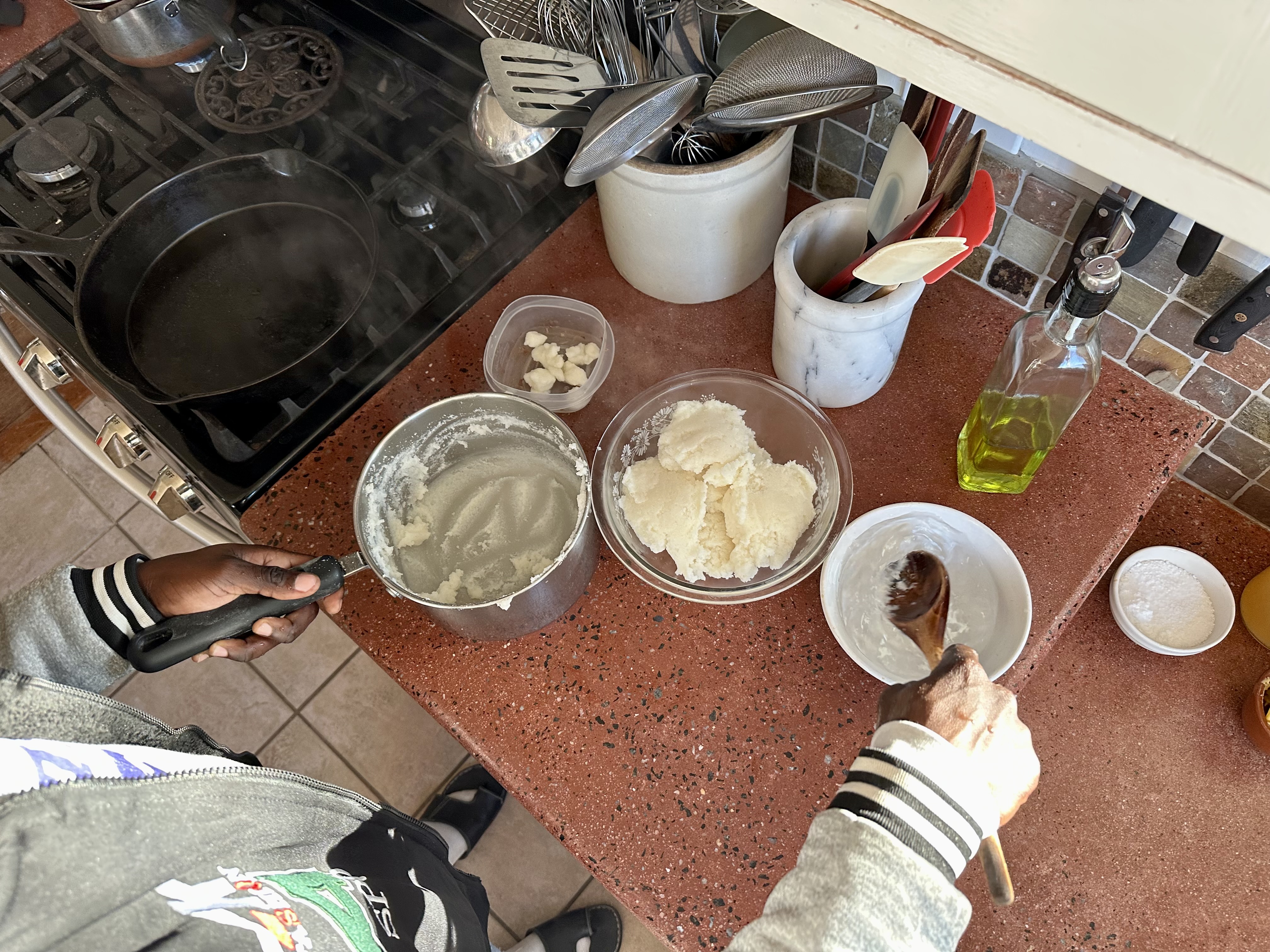
I’ve made a tomato-onion gravy and sautéed kale — both common in Mozambique, according to my research. Eucefe shows us how to scoop the xima with our fingers, roll it into a smooth ball, and then make an indent in it before dipping it in the gravy. We try, clumsily, then give up and reach for our forks, making it easier (and faster) to shovel the deliciousness into our mouths.
I’m scraping my plate clean when I realize I forgot to take a picture. “Stop!” I yell to Eucefe — he still has food left — and grab my camera. I make him bring his plate to the doorway where the light’s better, and he laughs, gamely holding still while I snap a shot.
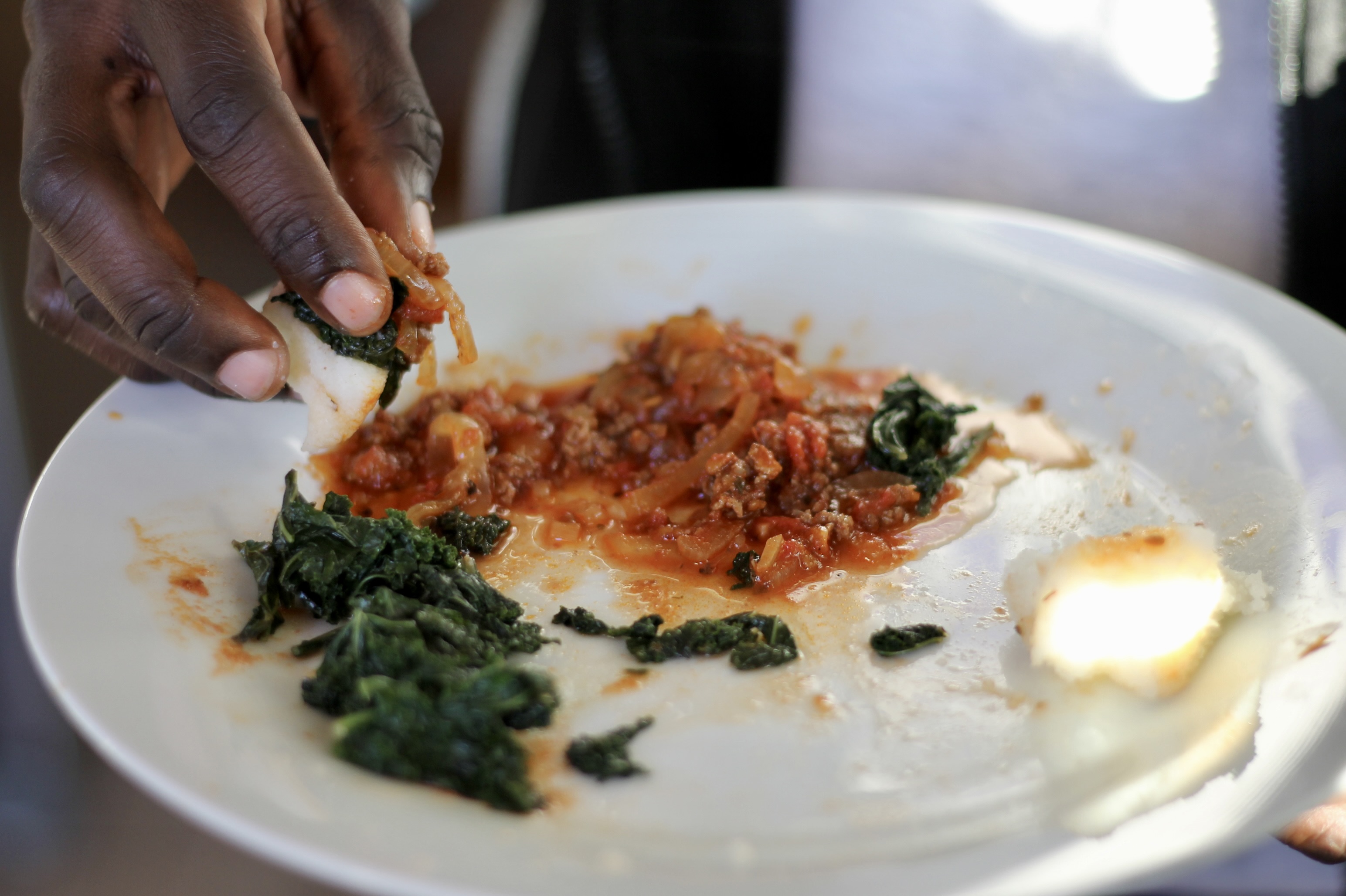
Eucefe’s xima
Eucefe’s “recipe” has no measurements. Quantities depend on how many people you are serving. The following proportions should serve 2-3 people.
In a heavy-bottomed saucepan, mix a cup or so of maize meal with enough water to make a loose, smooth slurry — maybe one cup of meal to two cups of water? Cook the slurry over medium high heat, stirring continuously. Once it bubbles, it will begin to thicken. Stir vigorously, adding more meal, a little at a time, until the xima is thick and very stiff. If lumps form, remove them.
Once the xima is the desired texture, turn off the heat. Transfer to a serving bowl using a clean spoon, dipping it in cool water between scoops to prevent sticking.
Serve hot, with a tomato-based sauce and a generous side of greens.